Elena Lloret (Invited Lecturer)
Keynote Speakers
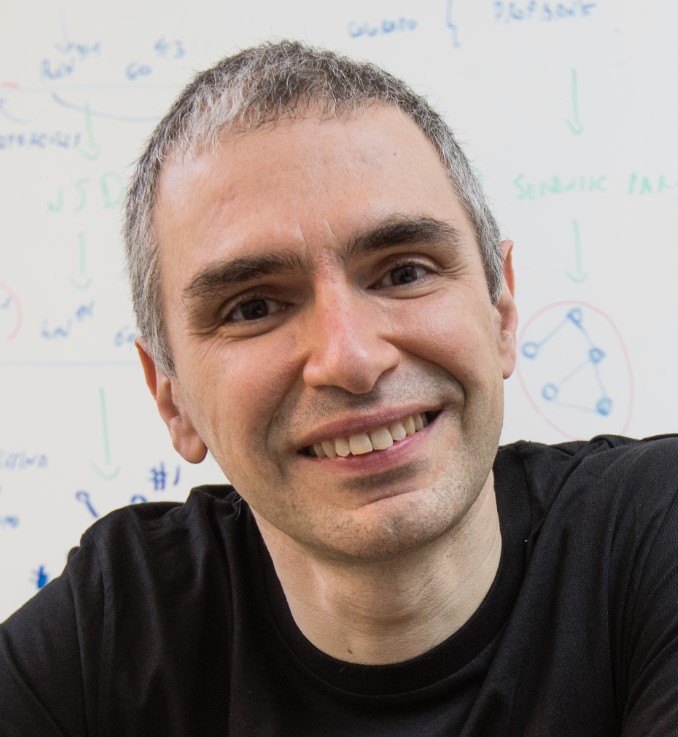
Roberto Navigli
Is Lexical Semantics Dead in the LLM Era?
Lexical semantics has long been central to NLP through tasks such as Word Sense Disambiguation, that is, identifying the intended meaning of a word in context. With the rise of Large Language Models, these meaning distinctions are increasingly handled implicitly.
The keynote revisits this task as part of a broader perspective on meaning in LLMs, showing that lexical semantics is not obsolete: it remains both an active area of research and a useful diagnostic tool for evaluating semantic competence, robustness, and interpretability.
Professor of Natural Language Processing at Sapienza University of Rome, ACL, AAAI, ELLIS and EurAI Fellow, General Chair of ACL 2025, and Scientific Director and co-founder of Babelscape.

Preslav Nakov
Towards Truly Open, Language-Specific, Safe, Factual, and Specialized Large Language Models
This keynote argues for large language models that are fully open, language-specific, safe, factual, and specialized. It draws on work at MBZUAI's Institute of Foundation Models, including open LLM efforts such as LLM360, Jais for Arabic, Nanda for Hindi, and Sherkala for Kazakh.
It also highlights the need for stronger guardrails, factuality, and domain specialization, presenting resources such as Do-Not-Answer and discussing how open, language-aware models can be developed more responsibly.
Professor and Department Chair for NLP at Mohamed bin Zayed University of Artificial Intelligence, leader of Jais and other multilingual open-weight LLMs, former Principal Scientist at QCRI, Chair of EACL, and author of 250+ research papers.
Topics
Lecturers
Tharindu Ranasinghe
Quality Estimation for Machine Translation
Hansi Hettiarachchi
Understanding Language Models
Salima Lamsiyah
Explainable AI in Natural Language Processing
Cengiz Acarturk
Gaze data for NLP research: Recording methods and analysis
Ernesto Luis Estevanell
Automated Hyperparameter Optimization and Model Selection for NLP Pipelines
Juan Pablo Consuegra-Ayala
Fairness in Machine Learning: Evaluating Gender Bias in LLMs
Isuri Anuradha
Beyond the Single Text: NLP Reading in Digital Humanities
Alicia Picazo-Izquierdo
Machine Translation for Low-Resource Languages
Robiert Sepulveda Torres
LLMs for low-resource languages
Damith Premasiri
Legal NLP in the NLP era
Maram Alharbi
Sentiment Analysis: From Rule-Based Methods to Large Language Models
About
Summer School Overview
Natural Language Processing has witnessed a clear paradigm shift from rule-based approaches to data-driven language models. While Deep Learning and Large Language Models have transformed the field, practical experience shows that model-based systems do not always outperform classical rule-based methods in every setting.
This summer school addresses that transition through an intensive 3-day programme that combines theoretical foundations with practical sessions. Core topics include LLMs, explainability, datasets and bias, low-resource languages, machine translation, sentiment analysis, model optimisation, and eye-tracking/gaze data for NLP.
The school is intended for newcomers and experienced participants in NLP, computer science, data science, cybersecurity, corpus linguistics, and related language-technology disciplines.
Explore
Calls for Participation
Participation details and registration updates.
Registration
Registration is now closed. Get in touch if you have questions about an existing registration.
Programme
Confirmed topics, speakers, keynote speaker, and detailed schedule updates.
Panel
Invited panellists, affiliations, and moderator details.
Organisation and Venue
Committees, directors/chair, venue information, social programme, and location details with map.